In Nigeria's floating slums, the focus of the “Herd” journey is climate change.

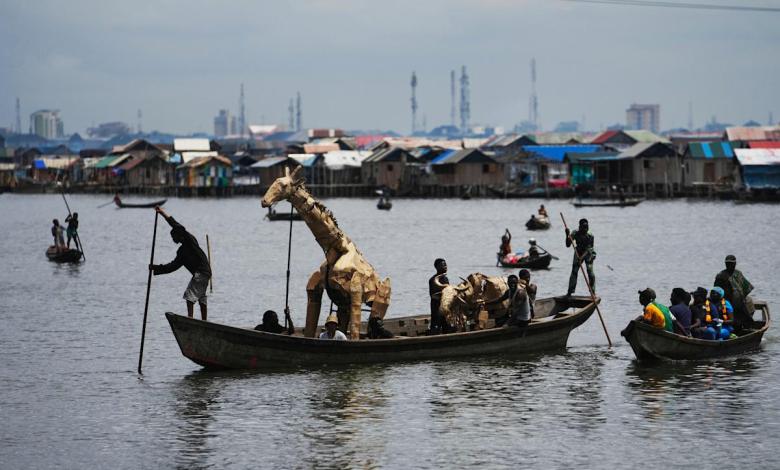
Nigeria Marcoko (AP) – Several canoes paddle towards Makoko, a huge floating slum built on stilts in the lagoon at one end of the economic hub of Nigeria Lagos. Riding on the boat are giant cardboard puppet animals, their puppets dressed in black.
Once on the water, these animals – gorillas, leopards, elephants, wild antelope, giraffe and donkey – are all alive. The gorilla hott, the donkey blows, sways and shakes its tail, as the leopard bends its neck to the surface, as if to drink, but when it stops on its face, the face stops water and then turns around and looks around.
It's Saturday, the second day of the Nigerian “Herdes” drama tour, from the Congo Basin in Africa to the Arctic Circle, 20,000 kilometers (12,427 miles) of Nigeria's journey with puppet animals. Organizers say it is a journey that aims to draw attention to the climate crisis and “reconnect with the natural world.”
The tour started last week in Kinshasa, the Congolese capital, and will continue with Dakar, the next stop in Senegal.
The story is that due to global warming and northward displacement, these animals will be forced to leave their natural habitat, stop in cities on the way, and be joined by more animals.
Amir Nizar Zuabi, artistic director of the Cattle Herd, said Makoko's sprawling slum (an old fishing village) is perfect for illustrative because it shows resilience in the face of climate change and often finds ways to adapt to extreme weather.
Makoko slums, known as Venice in Africa, are a low-lying community susceptible to sea level rise and flooding. Lagos itself is no stranger to the effects of climate change, with roads and houses in coastal cities often engulfing in annual floods.
“We are in one of the biggest crises in the world, and I think… the Global South provides a lot of knowledge and a lot of resilience,” Zubi said. He refers to developing countries in the southern hemisphere, which have lower incomes and higher poverty rates than the “Global North”.
As the “herd of cattle” moved in, Makoko was scattered under the third largest continental bridge connecting most of Lagos. Children and women stand on the plank porch outside the crumbling wooden house and watch the animals pass through the narrow waterway. Some imitate animals, while others applaud and wave to them.
“Looks real,” Samuel Shemede, a 22-year-old resident of Makoko, was in awe of the puppets. “I've never seen anything like this in my life. It's not true, but they look so real.”
When the tour left Makoko and moved to the suburbs of Yaba, the city's notorious traffic was still as they towered on people and vehicles. Large animals join in like smaller primates, such as monkeys, who clamor, look around, and even dance.
The dance and choreography of the tour pierced the local theater group, whose performers were dressed in beige sack materials and straw hats, intermittently charging puppets as if they were going to attack them.
As they cross the streets, the audience appreciates the ode from the Hausa language song “Amfara”, which loosely translates to “We've begun.”
At a time when African countries lose up to 5% of their GDP each year, they are burdened more than the rest of the world due to climate change, and the herd organizers say it is important to break down climate change and its impacts in ways that many people can relate to.
“Many climate debates are about science…and the scientific word doesn't mean anything to most people,” said Zuabi, artistic director. “I wanted to create a work of art that talks about nature, beauty and how wild and majestic animals.”
He said that the animals that invade cities are a metaphor for anomalous things because the whole world is dealing with climate change. “Hopefully this becomes a way to talk about what it will be lost if we continue to burn fossil fuels.”