

If any company understands, or should understand, the value of health data and its importance to patients' lives, it's Wisconsin-based EHR company Epic.
However, while the company announced a slew of future AI projects last August, including a digital companion for patients called Emmie, OpenAI (which announced ChatGPT for Health late last week) actually lets people query their own medical records and gain insights. Anthropic announced similar functionality for Pro and Max users of its Claude generative artificial intelligence platform. Like Epic, other companies that understand broad patient needs have missed the boat.
But in an interview Friday, Epic's chief medical officer pushed back against the idea that the EHR company is “missing an opportunity.”
“I would classify this as a missed opportunity because it was developed with years of thoughtfulness on top of other non-AI MyChart developments, and the AI is actually more thoughtful and tailored to your medical history and individual medical care,” said Dr. Jackie Gerhart, who is also a practicing family physician and vice president of clinical informatics.
Gerhart, who has been with Epic for seven years, and another Epic development expert painstakingly described how the company develops Emmie's features. Emmie is a digital concierge service embedded deep within the EHR that not only handles simple queries like “create an exercise plan” or “interpret my lab results” but also drives you to do the things you should do for better health.
“One of the features of Emmie that we released last year, around February or March, is that it looks at the doctor's instructions for previous appointments or admissions and creates actionable tasks for the patient. So when you log in as a patient, it tells you, 'Hey, here are two tasks that you need to track based on discharge instructions,'” said Borno Akhter, who has been with Epic for 14 years and currently leads the AI effort as a software developer.
Gerhart believes this is the fundamental difference between ChatGPT for Health and what Epic is developing.
“I think the experience you might have when you type something into ChatGPT is that you're able to get the information back, but it also requires you to type the information in and be a forger and manager of different information and then also know where to take action and follow up,” she explained. “I think the two key differences here are that we're not just giving patients information, we're actually looking at how to help them take action.”
This becomes especially apparent when a person undergoes surgery. If the patient logs into MyChart, Emmie can remind them what needs to be done.
“So the concierge also actually walks you through some pretty complex workflows like checking in, handling post-op appointments, and really being able to plan your entire trip based on the surgery you had. So instead of saying, 'I had knee surgery, what should I do next?' you don't even have to ask. It anticipates what you might need,” Gerhardt explained.
In other words, Epic's bet is that Emmie (when its functionality is fully available, and when your provider decides to pay Epic for this AI capability) will be a more powerful tool because it lives in the EHR, understands your medical situation better than you do, and can guide you through tasks beyond scheduling appointments or answering your medical questions. So far, early adopters include Rush University System of Health in Chickahoe, Ochsner Health in New Orleans and Lehigh Valley Health Network in eastern Pennsylvania (now part of Jefferson Health)
She and Akhter fundamentally believe that this capability should exist in the EHR, where most patient data is stored. Not surprisingly, Gerhart moderated some discussion of OpenAI's claim that ChatGPT for Health is HIPAA compliant, despite being outside the EHR. OpenAI also announced that it will not use patients’ medical data to train its learning models.
“I haven't seen them successfully complete the same certifications that an EHR-first company requires to become a HIPAA covered entity, so I think that remains to be seen, and it does beg the question. It's also free. So when I put my health care information into something that's free, I'm always curious about what happens with it and what the business model is there,” Gerhardt noted.
Here are some screenshots describing how Epic envisioned Emmie (story below):
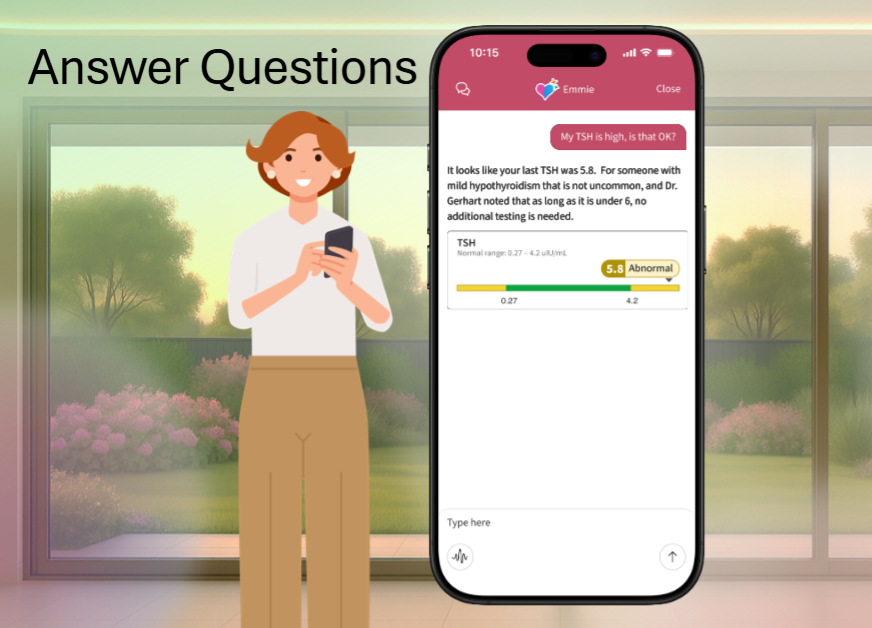
Users can also take a photo of their insurance card and upload it through the MyChart app, and Emmie can help answer questions about out-of-pocket costs and other insurance-related questions. Additionally, it can capture data from wearable devices through Apple HealthKit and Google Fit, Gerhart said.
“There's also a new Bluetooth standard where you can connect to MyChart directly from the device. So not yet, but maybe in the future, you'll see different devices on the shelves that claim to be MyChart enabled or directly able to connect to MyChart via Bluetooth,” she noted.
That's the problem.
Several slides in the presentation Gerhardt shared were dated. Some say “November 2025,” but Akhter says the features won't be available for another “month or two.” One of them said “November 2026.” Another simply said “the future.”
As Gerhart describes Epic's AI work with its digital companions, does “thoughtful development” necessarily mean slow? Innovation in healthcare needs to be thoughtful, given what's at stake—and everyone understands this. Still, one can't help but wonder—given the pent-up demand and the expertise held by large traditional healthcare companies—why innovation isn't happening faster.


