The government is trying to control Medicare Advantage costs. Will it work? – Center for Retirement Research


Controlling health care costs is critical for retirees.
Something good has happened recently. The Centers for Medicare and Medicaid Services (CMS) announced that its proposed 2027 average increase in Medicare Advantage plan rates that Medicare pays insurance companies is expected to be just 0.09%. Analysts had previously predicted that interest rate increases in 2027 would be roughly between 4% and 6%, consistent with the 5.06% rate increase by insurance companies in 2026.
The proposal is significant because Medicare Advantage plans are significant. By 2025, more Medicare enrollees will receive benefits through Medicare Advantage plans offered by private insurance companies rather than through traditional government-run Medicare, and this share is expected to continue to increase over time (see Figure 1).
People tend to choose Medicare Advantage plans for three reasons: 1) Enhanced benefits such as dental, vision, hearing, and fitness; 2) Annual out-of-pocket limits on Part A and Part B services (unlike traditional Medicare); 3) Low or no premiums. In return, participants must undergo the program's procedures, such as obtaining prior authorization for medical services and a more limited network of health care providers. Overall, however, it's easy to see why seniors often choose Medicare Advantage plans.
The biggest problem, however, is that Medicare Advantage plans are really expensive for Medicare. The Congressional Medicare Payment Advisory Commission estimates that by 2025, Advantage beneficiaries will pay 20 percent more than traditional Medicare. While Medicare generally pays participants for the services they actually receive, the plan pays Medicare Advantage plans a fixed amount per insured person. The amount is tied to a local benchmark, with higher amounts for higher-rated plans, and is risk-adjusted to reflect the health of each plan participant.
Because Medicare Advantage plans provide higher payments to enrollees with poorer health, insurance companies have an incentive to identify as many health conditions as possible for each enrollee. Not surprisingly, Medicare Advantage plans record more similar beneficiary health conditions than traditional Medicare.
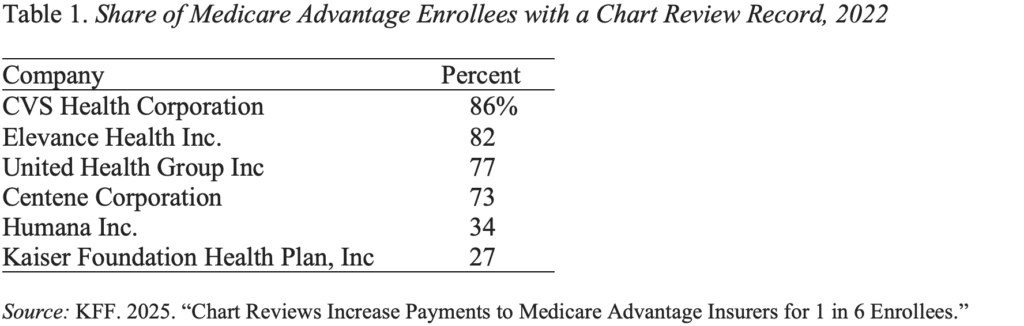
Analysts attribute the pattern, at least in part, to “chart reviews,” which insurance companies use to determine whether an individual's medical records are consistent with information submitted by providers. While chart reviews can identify other factors that may affect an individual's health status, they can also identify diagnoses that are inaccurate, no longer valid, or irrelevant to clinical care and therefore irrelevant for payment purposes. In 2022, 62% of MA enrollees had chart reviews, and these reviews were significantly more likely to add a diagnosis than to remove a diagnosis.
CMS announced it is keeping payments steady for Medicare Advantage plans through 2027, reflecting the agency's plans to update its risk adjustment model to better reflect current costs. A critical part of this work involves excluding from chart review calculated diagnostic information that is not relevant to a specific beneficiary encounter.
CMS will accept comments on the proposed raises until February 25, 2026, and then issue final rate increases on or before April 6, 2026. Clearly, this decision will have the greatest impact on companies that rely most extensively on chart review (see Table 1).
CMS has taken a bold step; here’s hoping the agency sticks to it. Controlling health care costs is critical to the financial security of current and future retirees.


